

That Little Voice
- Lucie Fournier

- Mar 5
- 3 min read
You know the one I’m talking about.
The one that makes you question everything.
The one that whispers, “Who do you think you are?”
It can steal your confidence and disturb your peace — especially when you’re standing at the edge of wanting more. To do more. To become more.
Here’s something important:
If the desire has come into your awareness, it is not random.
The longing to grow, expand, create, contribute — it appears when you are capable of meeting it. Your life does not highlight something you are fundamentally unable to step into. The timing may stretch you, but the calling itself is not an accident.
Still… that doesn’t make it comfortable.
Because growth rarely feels like confidence at first.
It often feels like exposure.
Like vulnerability.
Like being seen before you feel ready.
And that uneasy feeling of “I’m not good enough” or “Someone will find me out” is not proof that you are incapable.
It is proof that you are expanding.
When you stand on the edge of something bigger — a new role, a new level of visibility, a deeper purpose — your nervous system registers change as risk. Your mind scrambles for safety. It questions your qualifications. It replays past mistakes. It highlights everything you don’t yet know.
This isn’t failure.
It’s transition.
There are usually two voices present in these moments.
One is loud and urgent. It is protective. It wants familiarity, predictability, certainty.
The other is quieter. Steadier. It says, “There is more for you.”
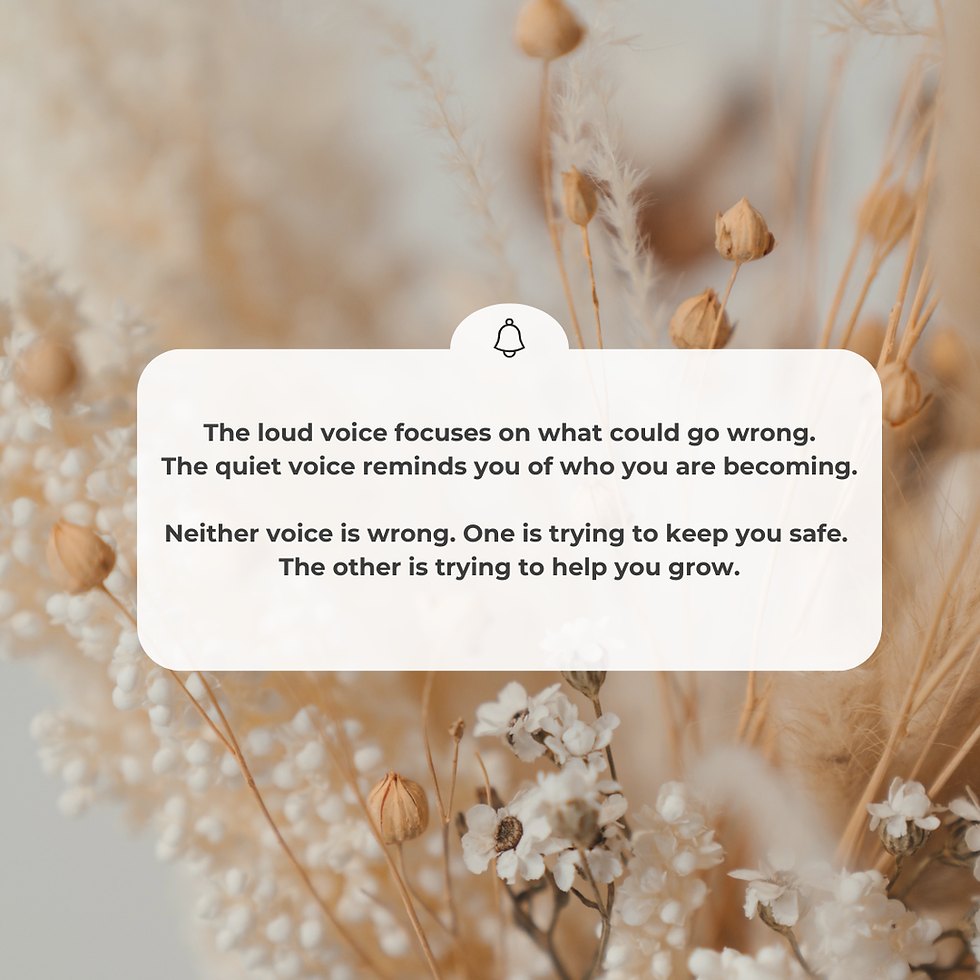
The loud voice focuses on what could go wrong.
The quiet voice reminds you of who you are becoming.
Neither voice is wrong. One is trying to keep you safe. The other is trying to help you grow.
The key is not to silence the protective voice with force.
It’s to reassure it.
You might say:
• It’s okay to be nervous.
• I don’t have to know everything to begin.
• Growth always feels unfamiliar at first.
• I am allowed to learn in public.

Discomfort is not a sign to retreat.
It is often a sign you are stretching beyond your previous identity.
Here are a few ways to manage this feeling when it surfaces:
1. Separate facts from fear
Write down what is actually true about your experience, training, wisdom, and lived knowledge. Then write down what your fear is predicting. Seeing the difference on paper reduces the emotional charge.
2. Focus on service, not self
When you shift from “Am I good enough?” to “Who can this help?” your attention moves from self-protection to contribution. Contribution quiets self-doubt.
3. Normalize being in process
Every expert you admire once felt unprepared. Mastery is built through repetition, not certainty.
4. Regulate your body
Slow breathing. A walk. Grounding your feet on the floor. The body must feel safe before the mind settles.
5. Take one visible step anyway
Growth requires action in the presence of discomfort. Small steps build evidence that you can handle more.
This phase passes.
Not because you eliminate uncertainty — but because your self-trust deepens.
Over time, what once felt terrifying becomes normal. What once felt like exposure becomes embodiment.
You do not become someone new.
You become more of who you already are.
If these feelings feel overwhelming or persistent, it may be helpful to speak with a coach, mentor, or therapist. Support is not weakness. It is strategy.
If you prefer reading, Susan Jeffers’ classic Feel the Fear and Do It Anyway offers a practical lens on moving forward despite uncertainty. It’s a reminder that courage is not the absence of fear — it’s movement alongside it.
Most importantly:
Breathe.
Trust the timing of your expansion.
Trust that the quiet voice exists for a reason.
You are not behind.
You are not a fraud.
You are in transition.
And transition is sacred ground.

Not sure where to start? Book a chat with me to see where is the best place for you to jump in and learn more about how I can help you!


Comments